
WWATF™ Learning Center
You’re Getting Clicks. Do You Really Need More Traffic?
More visitors may help—but before you chase a bigger number, look at who is arriving, why they clicked, where you sent them and what they are supposed to do next.

People are visiting your website, landing page, video or offer—but nothing useful seems to happen afterward.
Maybe the visits are not turning into readers. Maybe people arrive and leave without taking the next step. Maybe you are getting clicks, but you cannot tell whether those clicks are helping anyone move toward anything meaningful.
The natural conclusion is:
“I need more traffic.”
That reaction makes sense. If 100 visitors did not produce the result you hoped for, 1,000 visitors can sound like the obvious answer.
And sometimes more traffic really is needed. The problem is that traffic volume is only one part of the question. Before trying to increase the number, it helps to understand what is happening with the people who already arrive.
More traffic is not always better traffic.
That does not mean traffic is unimportant. It means a bigger traffic number does not, by itself, tell you whether useful movement is occurring.
“I Need More Traffic” Feels Like the Obvious Answer
You publish content, share links, promote an offer or operate a website. People see what you put in front of them. Some click. Some visit.
Then the result afterward is disappointing or unclear.
Maybe few people continue beyond the first page. Maybe they do not subscribe, download, watch or examine the offer. Maybe you cannot tell what they did after they arrived.
It is easy to look at that situation and decide that the problem must be the number of visitors.
But imagine sending more people down a road without first checking where the road leads. If the destination is confusing, unrelated to what attracted them or unclear about what comes next, a larger crowd may simply experience the same problem.
That does not prove the path is broken. It does not prove the visitors are wrong. And it does not prove that more traffic would not help. It simply means traffic volume should not be the only thing you inspect.
The better starting question is:
What is happening between the place people come from and the place I expect them to go next?
A Click Shows Movement—Not Whether the Whole Path Made Sense
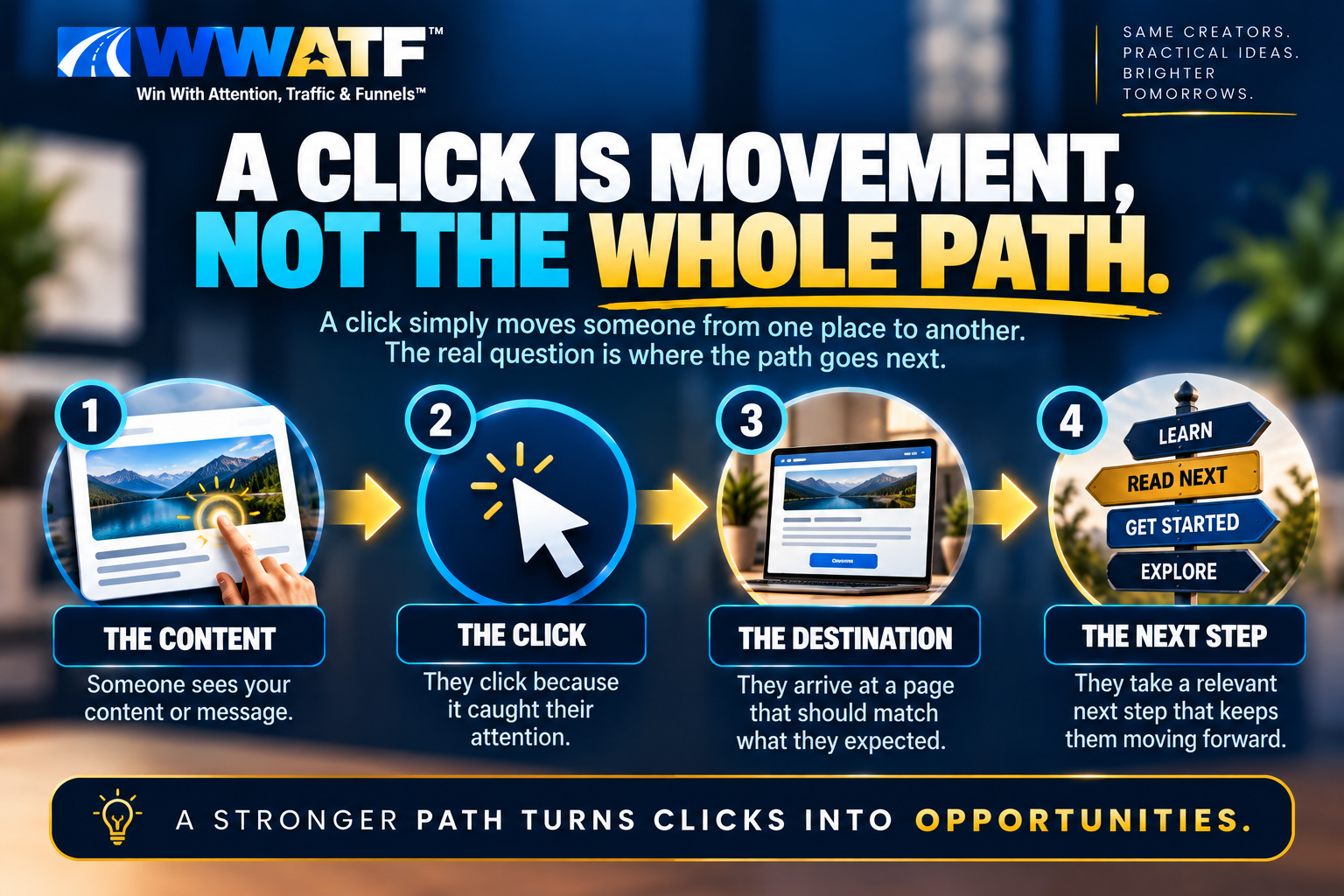
A click or visit tells you something real happened.
Someone moved from one place to another.
They may have moved from a social post to an article, from a search result to a webpage, from a video description to a product page, or from an email to a download page.
But the click alone does not tell you:
- whether the person was someone you intended to reach;
- whether they clicked for the reason you expected;
- whether the destination matched that expectation;
- whether they understood what to do after arriving.
Those are different questions.
A high click count can look encouraging while still leaving the rest of the path unclear. A lower click count can involve people who are strongly interested in the subject. Neither number, by itself, proves a business result.
Traffic is more useful to think about as movement—not just as a total on a dashboard.
Within Purposeful Traffic™, traffic is defined as purposeful movement of relevant people toward a defined destination.
The practical question is not only, “How many people clicked?” It is also, “Where were they trying to go, and did the path make sense once they moved?”
Start With the Right Person
Before asking how to get more website traffic, ask:
Who are you actually trying to move?
You do not need a complicated audience profile to begin. You need a reasonable understanding of who the message is meant to help or interest.
Suppose you publish a beginner’s guide to planning a first video. A new creator trying to decide what to say may be the right person for that resource. Someone searching for advanced camera specifications may click the same link, but the guide may not match what that person needs.
Both visits appear in the traffic count. They do not necessarily represent the same kind of movement.
Useful traffic does not begin with attracting anybody capable of clicking. It begins with making a clear connection between the subject, the person and the destination.
That alignment does not guarantee that the person will subscribe, buy or take another commercial action. It simply gives the visit a clearer reason to exist.
Give That Person the Right Reason to Click
Once you know who the message is for, ask:
Why would this person move from here to there?
A headline, post, video, recommendation, search result or email creates a reason to continue. It tells the person—directly or indirectly—what they can expect after clicking.
If a post says, “Use this checklist to decide what to fix before publishing again,” the person expects a checklist or practical decision aid. If a search result promises an explanation of why video views may be low, the person expects that subject to continue on the destination page.
The reason for clicking matters because it creates an expectation.
This is why getting clicks is not the whole job. You also need to understand what promise, question or interest moved the person in the first place.
Ask yourself:
- What did the headline or message lead them to expect?
- Was the reason to click clear?
- Did the message attract people who were likely to care about the destination?
You are not trying to read every visitor’s mind. You are checking whether the invitation you created reasonably connects with the place you sent them.
Send Them to a Destination That Matches
Now look at the destination and ask:
Does what they find match why they clicked?
Imagine someone clicks a post promising a simple guide to choosing a video topic. They arrive on a broad homepage filled with unrelated products, company updates and several competing buttons. The information they expected may be somewhere on the site, but the immediate connection is difficult to see.
Or imagine a person clicks a link about solving one specific problem and lands on a page discussing a different problem entirely. The click happened. The traffic count increased. But the path may not make sense from the visitor’s point of view.
That does not mean every destination must repeat the source word for word. It means the next page should continue the same basic conversation.
Inspect the destination as if you had never seen the business before:
- Is the expected subject easy to recognize?
- Does the opening confirm that the visitor is in the right place?
- Is the page focused enough for the reason they arrived?
- Is anything competing with the action or information they came to find?
The purpose is not to assume a mismatch exists. It is to look for one before deciding that more visitors are the only answer.
Make the Next Step Understandable
Arrival is not necessarily the end of the path.
Once someone reaches the destination, ask:
What are they supposed to do next?
The answer does not always have to be “buy.” Depending on the destination, the appropriate next step might be to:
- read;
- watch;
- learn;
- compare;
- subscribe;
- download;
- continue to another resource;
- examine an offer;
- take another appropriate action.
What matters is that the intended continuation makes sense for the person and the page.
A visitor may arrive at a useful article, finish reading it and still have no idea where to go next. A product page may explain the offer but make the purchase path difficult to recognize. A free resource may be relevant, but the page may not clearly show how to access it.
Again, that does not prove the next step is the cause of weak results. It gives you one more part of the path to inspect.
Put the Whole Traffic Path Together
The pieces can be brought together in one sequence:
Right People → Right Reason → Right Destination → Right Next Step
In ordinary language:
You are trying to reach people who are likely to care about the subject. You give them a relevant reason to click. You send them somewhere that continues what attracted them. Once they arrive, you make the intended next step understandable.
This is a practical way to examine whether the parts of a traffic path make sense together.
It is not a promise of more traffic, leads, conversions, customers, sales, revenue or profit. Even a well-considered path can produce different outcomes because commercial results depend on many additional factors.
But the sequence gives you something more useful to examine than traffic volume alone.
Try the One-Source Traffic Check
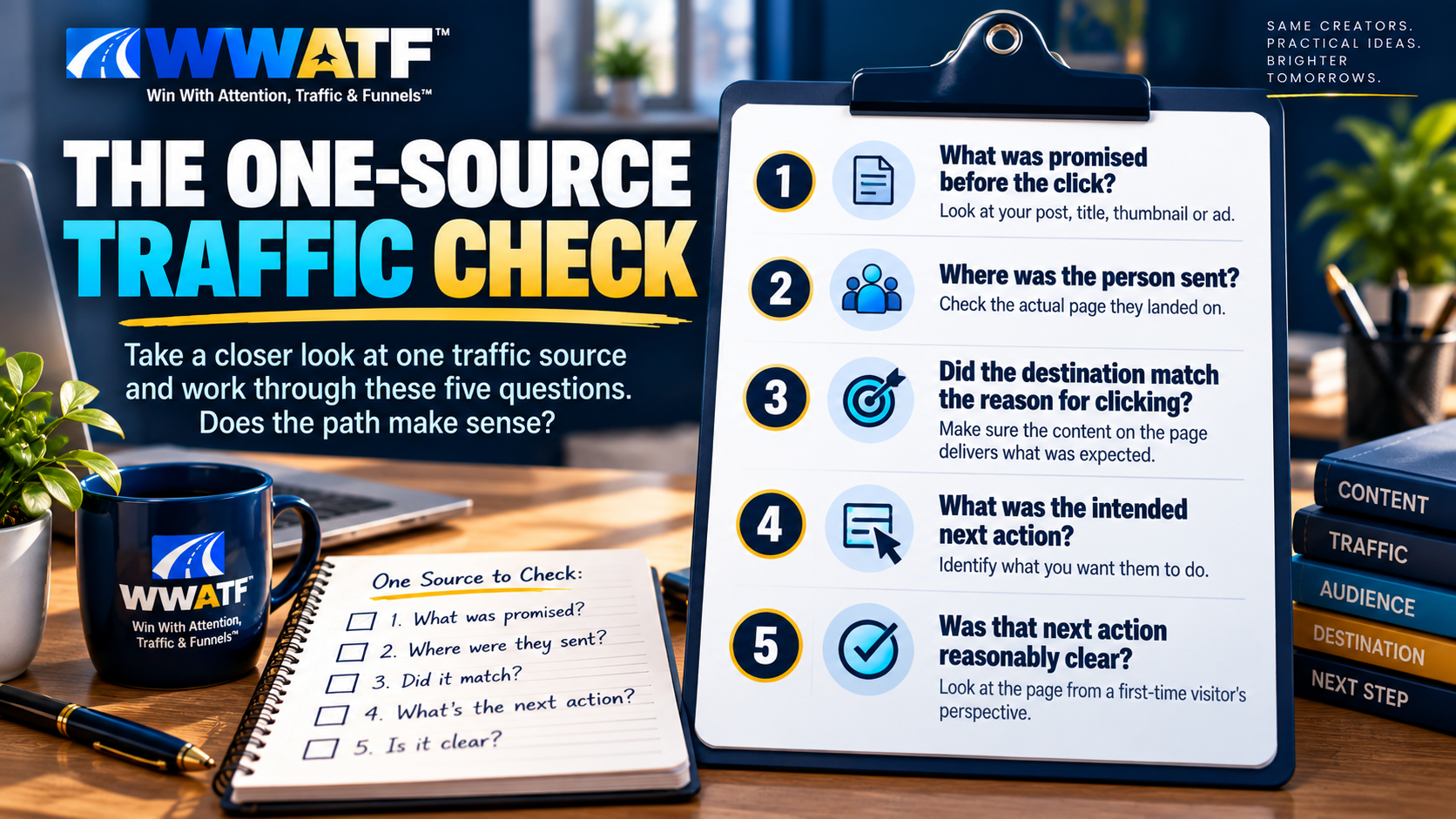
Choose one current traffic source. Do not try to audit everything at once.
It could be one social post, one video description, one email, one search result, one advertisement or one link you regularly share.
Then work through these five questions.
1. What did I promise before the click?
What did the post, headline, video, search result, email or other source lead the person to expect?
Write the promise in plain language. Do not describe what you meant internally. Describe what an ordinary person could reasonably expect from what they saw.
2. Where did I send them?
Identify the exact destination.
Was it an article, homepage, landing page, product page, video, download page or another resource?
3. Did the destination match the reason they clicked?
Look at the destination from the visitor’s point of view.
Could they quickly recognize the subject, promise or question that caused them to move?
4. What did I expect them to do next?
Name the intended continuation.
Were they supposed to read, watch, compare, subscribe, download, examine an offer or take another step?
5. Was that next step reasonably clear?
Do not answer only from what you know as the owner or creator. Consider what the arriving person could reasonably understand from the page itself.
After answering the five questions, look for the first place where the path becomes unclear.
You may discover something worth checking. You may also find that the path already makes sense and that traffic volume deserves further attention. The exercise does not predetermine the answer. Its purpose is inspection.
Purposeful Traffic Is Not the Same as Proven Business Results
A clear traffic path can help you think more deliberately about movement from source to destination. It cannot guarantee what happens commercially.
Purposeful traffic does not automatically produce:
- more traffic;
- leads;
- conversions;
- customers;
- sales;
- revenue;
- profit.
Those outcomes depend on additional factors, including the offer, the value provided, the audience’s needs, timing, trust, usability and the quality of the broader customer path.
The point is not to replace one oversimplified claim—“I just need more traffic”—with another.
The point is to ask better questions:
Who is arriving? Why did they come? Where did I send them? What did I expect them to do next?
More traffic may still be part of the answer. But before chasing a bigger number, understand the movement you already have.
Move Beyond “I Need More Traffic”
If you are trying to think more deliberately about who you want to reach, where those people are coming from, where you are sending them and what should happen next, Purposeful Traffic™ — How to Move the Right People From Discovery to the Right Destination provides a practical way to work through those questions.
It does not promise a traffic or business outcome. It continues the lesson by helping you examine the people, entry points, reasons, destinations and next steps involved in purposeful movement.
If you want a practical way to think through where your traffic is coming from, where it is going and what should happen next, explore Purposeful Traffic™ at wwatf.com/purposefultraffic.