
WWATF™ Campaign #001 · Attention
Your Content Isn’t Getting Seen. What Should You Actually Fix First?
Low views tell you what happened. Before you change your thumbnail, title, hook, or posting time, you still need to investigate why it happened.

You publish a video, check the numbers, and feel your stomach drop.
The views are lower than you expected.
Almost immediately, your mind starts searching for an explanation:
- Maybe the thumbnail is wrong.
- Maybe the title is weak.
- Maybe the opening did not grab people.
- Maybe you chose the wrong topic.
- Maybe you posted at the wrong time.
- Maybe the platform stopped showing your content.
Any one of those things might deserve a closer look. But the view count alone does not prove any of them.
That is the first distinction to make when your content is not getting seen:
The result is something you can observe. The cause is something you still have to investigate.
If you skip that distinction, you can spend hours fixing things without knowing whether they were actually broken.
Start With What Actually Happened
Begin with the part you know.
For example:
“This video received fewer views than I expected.”
That is an observation. You can look at the result and confirm it.
Notice what the sentence does not say. It does not say the thumbnail failed. It does not say the algorithm suppressed the video. It does not say the audience has lost interest in you. It simply describes what happened.
You can make the observation more useful by adding context:
- How many views did the video receive?
- What did you expect, and what was that expectation based on?
- How does the result compare with your recent content?
- Did the views start slowly, stop suddenly, or continue building over time?
- Was this content meant for the same audience as the posts you are comparing it with?
The goal is not to collect every number available. It is to describe the result accurately before attaching a story to it.
That matters because “this video underperformed compared with my last five similar videos” gives you something clearer to investigate than “the platform does not like my content anymore.”
Pay Attention to What You Are Assuming

Creators often move from observation to explanation so quickly that the two feel like the same thing.
“My views dropped” becomes “my thumbnail is bad.”
“The video stalled” becomes “the algorithm stopped showing it.”
“This post did worse than the last one” becomes “my audience is no longer interested.”
These explanations may be possibilities. They are not established facts merely because the views were low.
A simple way to slow the process down is to separate two questions:
- What do I know from the result?
- What do I think might have caused it?
Suppose your video received fewer views than usual. You might reasonably wonder whether the thumbnail made the subject unclear. That gives you a possible question to investigate:
“Could someone understand what this video offers from the thumbnail and title?”
That is different from declaring:
“The thumbnail caused the low views.”
The first statement opens an investigation. The second closes the case before you have examined it.
The same caution applies to claims about platform behavior. A disappointing result does not, by itself, prove suppression, a shadowban, or an algorithm change. If you do not have evidence for the cause, treat it as a possibility—not a conclusion.
Is This One Weak Result or a Recurring Pattern?
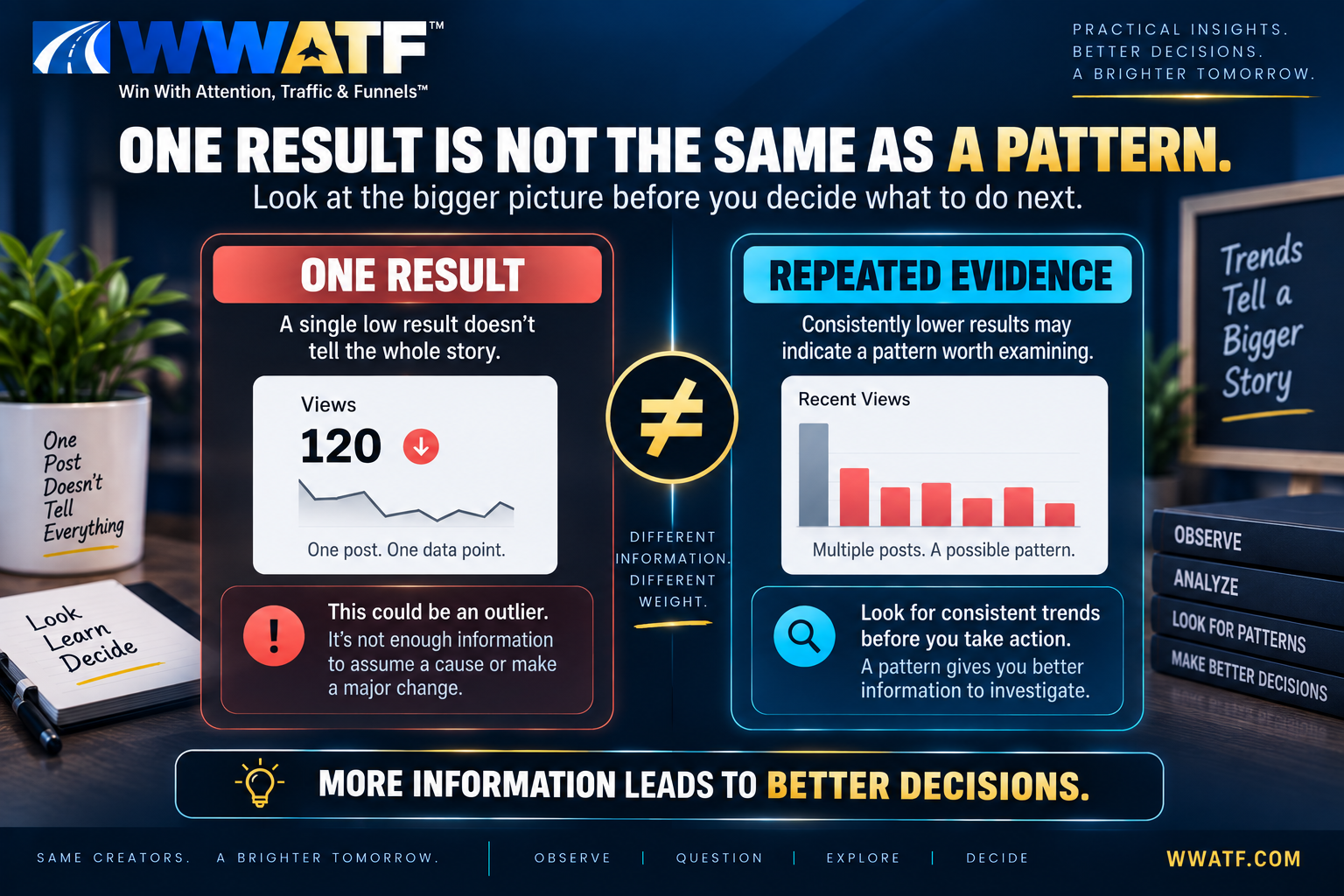
One disappointing post can feel bigger than it is, especially when you invested time and effort in creating it.
But one result and a recurring pattern are not the same thing.
A single video may perform differently because of its subject, packaging, audience fit, timing, format, competition for attention, or factors you cannot clearly identify. That does not mean you should ignore the result. It means you should be careful about using one result to explain your entire content strategy.
Look at comparable content instead of one isolated number. Ask:
- Are several recent posts showing the same kind of weakness?
- Is the decline happening across similar topics and formats?
- Is one post unusually weak while the others remain within their normal range?
- Did something specific change before the pattern appeared?
You do not need to pretend a small group of posts gives you statistical certainty. You are simply trying to determine whether you are reacting to one event or investigating something that keeps happening.
That distinction affects what you do next. One weak post may call for observation and comparison. A repeated pattern may justify a more deliberate review.
Don’t Fix Everything at Once
When views are low, changing everything can feel productive.
You replace the thumbnail, rewrite the title, shorten the opening, switch the format, choose a different topic, and post at another time.
Then the next video does better.
What did you learn?
Not much. Because several things changed at once, you cannot tell which change mattered—or whether the different result had another cause entirely.
This does not mean every content test has to resemble a laboratory experiment. It means your changes should help you learn.
A more useful approach is:
Change one meaningful thing. Compare what happens. Then decide what to do next.
For example, if the topic appears to be relevant but the promise is difficult to understand at a glance, you might inspect the title-and-thumbnail combination first. If people start the video but leave almost immediately, the opening may deserve attention before the thumbnail. If several posts attract the wrong audience, the problem may begin with topic and audience alignment rather than presentation.
The point is not that one of these examples must be your answer. The point is to choose a change because it matches the problem you are investigating.
Decide What Deserves Checking First
You may have several plausible concerns. The job is not to fix all of them today. It is to choose a sensible first priority.
Ask yourself:
- What result am I trying to understand?
- What evidence do I already have?
- Which explanation is only an assumption?
- Is there a repeated pattern or only one disappointing result?
- What is the most relevant thing I can inspect or change first?
- If I make that change, what will I compare afterward?
Your first priority should connect to the evidence you can actually see.
If the video is receiving impressions but few people choose to watch, the presentation may deserve investigation. If people begin watching but leave quickly, the opening and the match between the promise and the content may deserve a closer look. If the content reached people who were unlikely to care about the next step, audience fit may be more important than the raw view total.
Those are directions for investigation, not automatic diagnoses. The article cannot examine your individual content, and one metric rarely tells the whole story. But you can still make a more deliberate decision than “the views are low, so I should change everything.”
After you choose a first priority, write down what you are changing and why. Then give yourself something specific to re-check. That way, the next result can add information instead of starting another round of guessing.
Diagnose First. Fix Second.
“Diagnose first” does not mean you should never change anything.
It means you should not start changing things before you know what problem you are trying to solve.
Low, stalled, or falling views can tell you that the result deserves attention. They cannot automatically tell you whether the issue is the thumbnail, title, topic, opening, format, timing, audience fit, platform distribution, or some combination of factors.
So begin with the result. Separate what you observed from what you assumed. Decide whether you are looking at one event or a recurring pattern. Choose the most relevant thing to investigate first. Make a meaningful change when the evidence gives you a reason to make it. Then compare what happens.
That process may feel slower than immediately replacing everything. In practice, it can save you from making a pile of changes that teach you nothing.
Your result tells you what happened.
It does not automatically tell you why.
And before you start fixing things, you should know what you are actually trying to fix.
Need a Practical Way to Work Through the Question?
If you are looking at low, stalled, or falling views and you are still asking, “What should I actually fix?”, WHY ISN’T MY CONTENT GETTING SEEN?™ gives you a practical way to separate observation from assumption, identify what deserves investigation, and choose a first-fix priority.
It does not promise a particular number of views or pretend every weak result has one simple cause. It helps you approach the problem more deliberately: diagnose first, then decide what to fix.
Continue here: WHY ISN’T MY CONTENT GETTING SEEN?™